- Form: Liquid
- Appearance: Brown
Enzylase
Thermostable α-Amylase for Efficient Starch Control in Sugar Manufacturing
Managing Starch for Better Sugar Processing
Starch is one of the most common impurities encountered during sugar manufacturing. Depending on cane variety, climatic conditions, and harvesting practices, excess starch can enter the process stream and create operational challenges throughout the factory.
As starch accumulates, it increases juice viscosity, affects clarification, slows filtration, impacts pan boiling, and can influence sugar quality and overall process efficiency. Without effective starch management, mills may experience inconsistent processing, higher operational losses, and reduced plant performance.
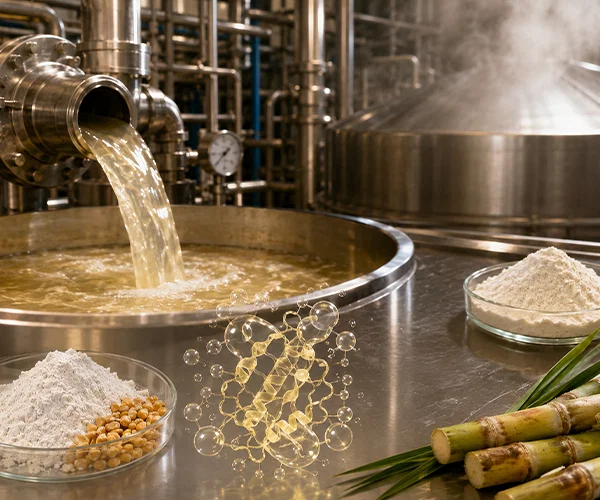
Enzylase is a high-performance thermostable α-amylase developed to effectively hydrolyse starch during sugar manufacturing. By breaking down starch into smaller, soluble molecules, it helps improve juice flow, supports efficient clarification, and enables smoother downstream processing.
- Controls excess starch throughout the sugar manufacturing process
- Reduces juice viscosity for smoother processing
- Improves clarification and filtration efficiency
- Enhances pan boiling performance
- Supports improved ICUMSA colour
- Helps maintain consistent process efficiency
- Contributes to better overall plant productivity
Enzylase can be applied across multiple stages of sugar manufacturing, including :
- Milling & Juice Extraction
- Juice Clarification
- Evaporation
- Vacuum Pan Boiling
- Crystallization
- Refinery Operations

Form
Liquid

Shelf Life
Minimum 6 months below 30°C

Packaging
30 kg HDPE Drums

Dosage
3–5 ppm (3–5 g per ton of cane crushed) depending on starch levels
25–30 ppm on raw sugar
A leading sugar manufacturing facility was looking to improve starch control across critical process streams to support smoother sugar processing and better downstream performance. To address this requirement, The Catalysts Group evaluated Enzylase at a dosage of 5 ppm and monitored starch levels across key juice, syrup, massecuite, and molasses streams.
The evaluation demonstrated a significant reduction in starch levels, with reductions of 61–89% across the streams where before-and-after comparison was available, and an overall reported average reduction of 77%.
- Controls excess starch throughout the sugar manufacturing process
- Reduces juice viscosity for smoother processing
- Improves clarification and filtration efficiency
- Enhances pan boiling performance
- Supports improved ICUMSA colour
- Helps maintain consistent process efficiency
- Contributes to better overall plant productivity
Enzylase can be applied across multiple stages of sugar manufacturing, including :
- Milling & Juice Extraction
- Juice Clarification
- Evaporation
- Vacuum Pan Boiling
- Crystallization
- Refinery Operations

Form
Liquid

Shelf Life
Minimum 6 months below 30°C

Packaging
30 kg HDPE Drums

Dosage
3–5 ppm (3–5 g per ton of cane crushed) depending on starch levels
25–30 ppm on raw sugar
- High molecular weight anionic flocculant for efficient clarification
- Delivers rapid and effective floc formation
- Performs reliably across varying process conditions
- Reduces chemical usage while improving settling efficiency
- Suitable for both sugar manufacturing and industrial wastewater treatment
- Supports cleaner operations and improved process performance
A leading sugar manufacturing facility was looking to improve starch control across critical process streams to support smoother sugar processing and better downstream performance. To address this requirement, The Catalysts Group evaluated Enzylase at a dosage of 5 ppm and monitored starch levels across key juice, syrup, massecuite, and molasses streams.
The evaluation demonstrated a significant reduction in starch levels, with reductions of 61–89% across the streams where before-and-after comparison was available, and an overall reported average reduction of 77%.
FAQ's
Residual starch increases juice viscosity and interferes with clarification. ENZYLASE hydrolyzes starch into soluble dextrins, improving juice flow and enabling more efficient solid-liquid separation.
Yes. By reducing starch-related viscosity, ENZYLASE allows clarifiers and downstream equipment to operate under more favorable conditions without requiring changes to existing plant equipment.
Symptoms may include higher juice viscosity, inconsistent clarification, poor pan boiling, and slower downstream processing. These are common indicators that starch accumulation is impacting plant performance.
A 1x investment in Enzylase generates 4.9x in value, based on a 10,000 TCD plant, 5 ppm dosage, and 1 kg additional sugar recovery per tonne of cane.
Other Solutions
info@thecatalystsgroup.com


GET IN TOUCH