Grain fermentation presents several operational challenges for distilleries, including uneven particle size due to milling variations, lower starch conversion efficiency caused by improper enzyme selection, and the use of unsuitable yeast for high gravity fermentation. These factors reduce fermentation efficiency, resulting in lower ethanol yield and decreased plant profitability. Selecting the right Alpha Amylase and Glucoamylase enzymes is critical for efficient liquefaction, saccharification, and maximum starch conversion during the grain-to-ethanol process.
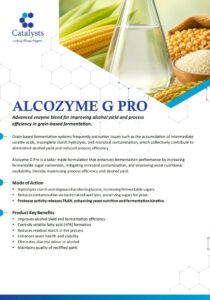
Alcozyme G Pro
Form: Powder
Appearance: Off-white to Brownish
Key Benefits
- Improves alcohol yield and fermentation efficiency
- Controls volatile fatty acid (VFA) formation
- Reduces residual starch in the process
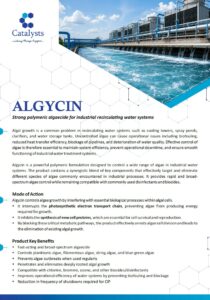
Algycin
Form: Viscous Liquid
Odor: Pungent
Key Benefits
- Fast-acting and broad-spectrum algaecide
- Controls planktonic, filamentous, string, and blue-green algae
- Helps prevent algae outbreaks with regular use
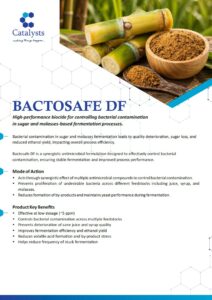
Bactosafe DF
Form: Liquid
Key Benefits
- Effective at low dosage levels
- Controls bacterial contamination across multiple feedstocks
- Prevents deterioration of cane juice and syrup quality
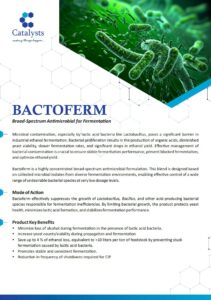
Bactoferm
Form: Liquid
Key Benefits
- Minimizes alcohol loss in the presence of lactic acid bacteria
- Increases yeast counts and viability during propagation and fermentation
- Helps save up to 4% ethanol loss
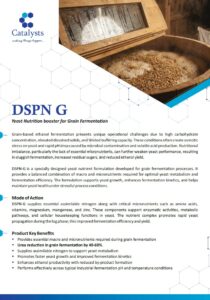
DSPN G
Form: Powder
Appearance: Off-white to Brown
Key Benefits
- Provides essential macro and micronutrients required during grain fermentation
- Supports 40–60% reduction in urea use in grain fermentation
- Supplies assimilable nitrogen for yeast metabolism
DSPN Pro
Form: Powder
Appearance: Off-white to Pale Yellow/Brown
Key Benefits
- Provides essential nutrients required for yeast during fermentation
- Ensures balanced nitrogen availability
- Promotes higher yeast productivity
Enzyliq DS
Form: Liquid
Appearance: Pale Yellow
Key Benefits
- Improves liquefaction rate to achieve desired DE in minimum time
- Performs efficiently at high dry solids levels
- Requires lower dosage due to high enzyme activity
Natunutr-DSPN
Form: Powder
Appearance: Off-white to Light Brown
Key Benefits
- Provides complete nutrition for yeast during fermentation
- Eliminates the need for external nitrogen sources such as urea or ammonia
- Enhances yeast growth and viability
ProColor-TS
Form: Powder
Appearance: Pink-Coloured Powder
Key Benefits
- Enhances rice DDGS colour to golden yellow, similar to maize DDGS
- Improves nutritive value by increasing calcium and phosphorus content
- No adverse impact on fermentation by-products
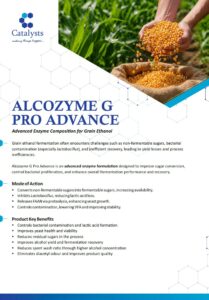
Alcozyme G Pro Advance
Form: Powder
Appearance: Off-white to Brownish
Key Benefits
- Controls bacterial contamination and lactic acid formation
- Improves yeast health and viability
- Reduces residual sugars in the process
Grain fermentation presents several operational challenges for distilleries, including uneven particle size due to milling variations, lower starch conversion efficiency caused by improper enzyme selection, and the use of unsuitable yeast for high gravity fermentation. These factors reduce fermentation efficiency, resulting in lower ethanol yield and decreased plant profitability. Selecting the right Alpha Amylase and Glucoamylase enzymes is critical for efficient liquefaction, saccharification, and maximum starch conversion during the grain-to-ethanol process.
Maintaining effective CIP practices and controlling contamination are equally important. Microbial contamination from raw materials, process water, or equipment consumes valuable fermentable sugars and produces harmful organic acids such as lactic acid. These by-products negatively affect yeast health, reduce ethanol yield, and often lead to stuck fermentation.
Additional challenges include lower decanter and evaporation efficiencies, which directly affect DDGS quality and overall process economics. Distilleries must address these operational challenges to achieve consistent grain fermentation, maximize ethanol production, and improve plant profitability.
Our Products
Our products are designed to improve fermentation efficiency, control bacterial contamination, provide essential yeast nutrition, and enhance DDGS quality. We offer complete enzyme packages for grain-to-ethanol processes, including high-performance Alpha Amylase and Glucoamylase enzymes for efficient liquefaction and saccharification.
Our portfolio also includes premium Active Dry Yeast (Leaf by Lesaffre) for grain ethanol and high gravity fermentation, along with advanced contamination control solutions. As a trusted industrial enzyme supplier for distilleries in India, we help ethanol producers improve process efficiency, maximize ethanol yield, and achieve consistent fermentation performance.
Alcozyme G Pro Advance
Advanced Enzyme Composition for Grain Ethanol
Grain ethanol fermentation often encounters challenges such as non-fermentable sugars, bacterial contamination (especially lactobacillus), and inefficient recovery, leading to yield losses and process inefficiencies
Alcozyme G Pro
Advanced enzyme blend for improving alcohol yield and process efficiency in grain-based fermentation.
Grain-based fermentaon systems frequently encounter issues such as the accumulaon of intermediate volale acids, incomplete starch hydrolysis, and microbial contaminaon, which collecvely contribute to diminished alcohol yield and reduced process efficiency.
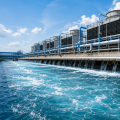
Algycin
Algal growth is a common problem in recirculating water systems such as cooling towers, spray ponds, clarifiers, and water storage tanks.
Bactosafe DF
Bacterial contamination in sugar and molasses fermentation leads to quality deterioration, sugar loss, and reduced ethanol yield, impacting overall process efficiency
Bactoferm
Broad-Spectrum Antimicrobial for Fermentation. Microbial contamination, especially by lactic acid bacteria like Lactobacillus, poses a significant barrier in industrial ethanol fermentation. Bacterial proliferation results in the production of organic acids, diminished yeast viability, slower fermentation rates, and significant drops in ethanol yield. Effective management of bacterial contamination is crucial to ensure stable fermentation performance, prevent blocked fermentation, and optimize ethanol yield.
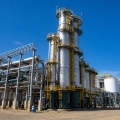
DSPN G
Grain-based ethanol fermentation presents unique operational challenges due to high carbohydrate concentration, elevated dissolved solids, and limited buffering capacity.
DSPN Pro
Ethanol fermentation often faces challenges such as nutrient imbalance, yeast stress, and inefficient metabolism, resulting in lower productivity and inconsistent performance.
Enzyliq DS
Industrial starch processing requires efficient liquefaction of gelatinized starch at high temperatures. High slurry viscosity during liquefaction reduces process efficiency, increases energy consumption, and creates operational challenges in jet cookers and heat exchangers.
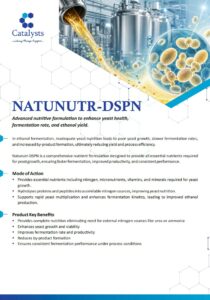
Natunutr-DSPN
Advanced nutritive formulation to enhance yeast health, fermentation rate, and ethanol yield.
In ethanol fermentation, inadequate yeast nutrition leads to poor yeast growth, slower fermentation rates, and increased by-product formation, ultimately reducing yield and process efficiency.
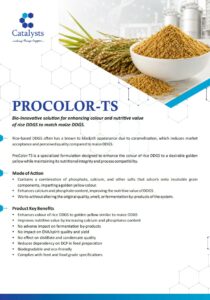
ProColor-TS
Bio-innovative solution for enhancing colour and nutritive value of rice DDGS to match maize DDGS.
Rice-based DDGS often has a brown to blackish appearance due to caramelisation, which reduces market acceptance and perceived quality compared to maize DDGS.
Common Questions on Sugarcane Processing
Answers to the most asked questions about sugarcane processing challenges and enzymatic solutions.
What challenges does the sugar industry face in sugarcane processing?
The sugar industry faces challenges including dextran formation causing sucrose loss, slower crystal growth forming elongated or needle-shaped crystals, high viscosity and blocked crystal faces causing incomplete crystallization, poor clarification increasing colour and ash in sugar, acid beverage floc development, and deterioration of stored molasses and syrup.
What enzymatic products does The Catalysts Group offer for sugarcane processing?
The Catalysts Group offers Enzylase (alpha amylase for starch hydrolysis), Enzydex (dextranase for dextran hydrolysis), Enzysweet (liquid protease), Bactosafe (mill sanitizer), BactoShield (USFDA-approved QAC sanitizer), Enzycolour Go-J and Enzycolour Go-R (colour precipitating agents for Phospho-flotation), Catfloc-J and Catfloc-R (anionic flocculants), and Enzymol Protect Advance (B-Heavy Molasses preservation).
How does Enzymol Protect Advance help sugar factories?
Enzymol Protect Advance is designed and implemented by the Catalysts team to preserve reducing sugars in B-Heavy Molasses during storage. Its implementation guarantees zero loss of sugars in Molasses while storage up to 6 months. It saves huge losses — up to 15% — to Sugar Factory or allied Distilleries being suffered due to deterioration of sugars in Molasses while in storage.
What is Enzydex used for in the sugar industry?
Enzydex is a fungal dextranase (1,6-alpha-P-glucan 6-glucanohydrolase) obtained by the controlled fermentation of Penicillium Paecilomyces. It has been designed and developed by the Catalysts R&D team for hydrolysis of the interior alpha-1-6-glucosidic bond of dextran and its degradation products — directly addressing the dextran problem in sugar juice processing.
What challenges does the sugar industry face in sugarcane processing?
The sugar industry faces challenges including dextran formation causing sucrose loss, slower crystal growth forming elongated or needle-shaped crystals, high viscosity and blocked crystal faces causing incomplete crystallization, poor clarification increasing colour and ash in sugar, acid beverage floc development, and deterioration of stored molasses and syrup.
info@thecatalystsgroup.com


GET IN TOUCH